
Precision optics present challenges in the phases of design, prototyping, scaling, and production. In the previous part of this blog series, we began by discussing the challenges to design. However, prototyping and production often create the largest technical issues. Your simulated optical design will now meet the harsh reality of the physical world. Ensuring it survives and performs will be vital to securing your product’s lead in the marketplace.
In the first blog in this series, we discussed why optical technologies are proliferating across industries, including defense, medical, and industrial systems. We also looked at the complexities of optical design, why it can be difficult to develop custom optics if that is not your team's core competency, and how a design and manufacturing partner like Benchmark can help. In this blog, we'll dive into more detail on the transitions from design to prototype and from prototype to production.
Overcoming Optical Prototyping Challenges
Limitations in manufacturing and assembly capabilities often restrict how much a design can be practically improved. For example, engineering and manufacturing partners may struggle to reproduce precision or handle design complexity, and a lack of experience in other areas like microelectronics can also hinder your plans to innovate optics. We outline these technical challenges and their relationship to optics manufacturing in our webinar. In real-world applications, optics are not just glass lenses, but complex assemblies of precision metal housings, adhesives, sensors, lasers, and even electromechanical assemblies for steering light. This complexity is clear in another lidar device we manufactured for a client - every extra component reduces the margin for error and compounds the precision required to ensure proper light transfer for sensing, imaging, or energy delivery. These factors can be accounted for in advanced software tools, but real-world products introduce many complicating variables.
To make a precision optical system, prototyping comes first. An engineering or manufacturing partner will typically begin by taking your existing prototype and reproducing it in their own labs. The challenge is precision. Even if the partner aims to build to the same specifications in their own labs, they may struggle to reproduce the performance of the optics, due to environmental factors, lack of accuracy, inability to dispense adhesives or apply coatings to the correct specifications, or simply a lack of appropriate equipment. Regardless, creative approaches usually overcome these obstacles. Makeshift solutions can be suitable for complex products destined for low-volume production, and with functional prototypes complete, you’ve reached a milestone in product development because they can be delivered to end-customers or internal engineers who test them in the larger system they are building.
Overcoming Optical Production Challenges
The larger challenge comes with scaling production. With a process for producing accurate prototypes in place, orders for your end-product are likely on the horizon and it is now time to build hundreds or thousands of units. Prototypes may take days to produce, but now you need to produce many per day, requiring you to develop a manufacturing process from scratch. Off-the-shelf solutions can help with portions of the process, but typically leave gaps in capability or fail to meet the accuracy requirements, and if your optical system is small, you will be under pressure to find a way to handle delicate optics at fast speeds while inserting it into a small space. Finally, optics are almost always integrated with microelectronics and electromechanical systems to control them. If you don’t have these capabilities in-house, your manufacturing partner will need to; otherwise, you will need to fund the additional expertise or equipment needed.
What do the prototyping and production phases for optics have in common? Usually, not much. However, at Benchmark, our approach to optics involves deploying flexible automation, advanced technology, and in-house, cross-disciplinary engineering teams in both phases.
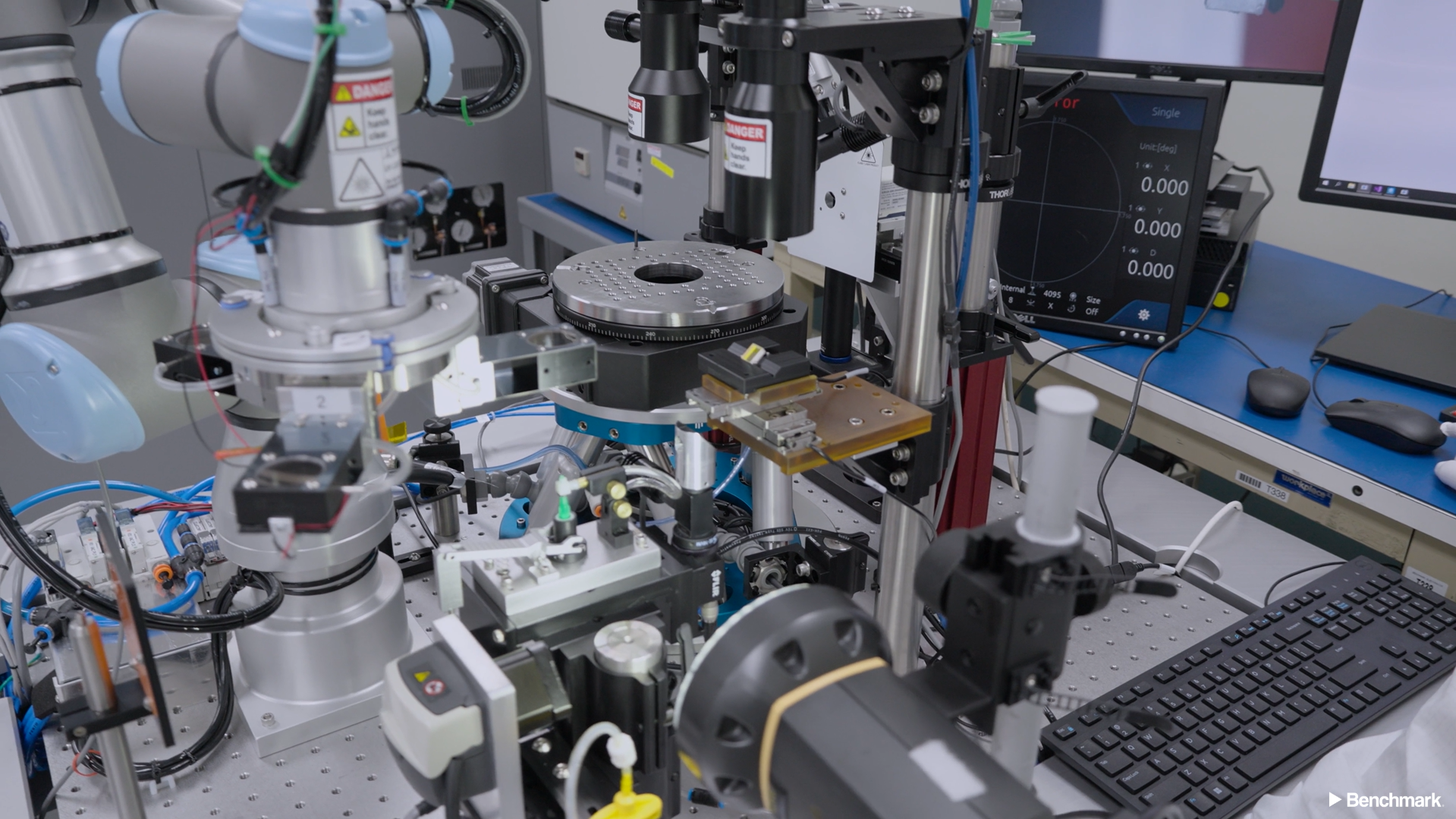
Automation lowers costs and improves precision, but it does not lend itself well to complex products. Typical automation, designed for high-volume manufacturing, often fails to meet high-precision needs in medical and industrial applications. It increases precision along strict dimensions, involves significant capital investment, and requires specialized engineers; as a result, most manufacturers delay implementation until they scale up production.
Benchmark employs an innovative approach to optics by using flexible automation from the start of prototyping, using advanced and modular technology such as software-defined robots, which offer dexterity and precision. We also use high-precision robotics—such as hexapods for micron-level adjustments, machine vision for accurate adhesive dispensing, and custom end-effectors that handle delicate optics and fit them into tight spaces. Watch our automated optical assembly video to see this in action and how it ensures prototypes are precise and suitable for beta unit testing.
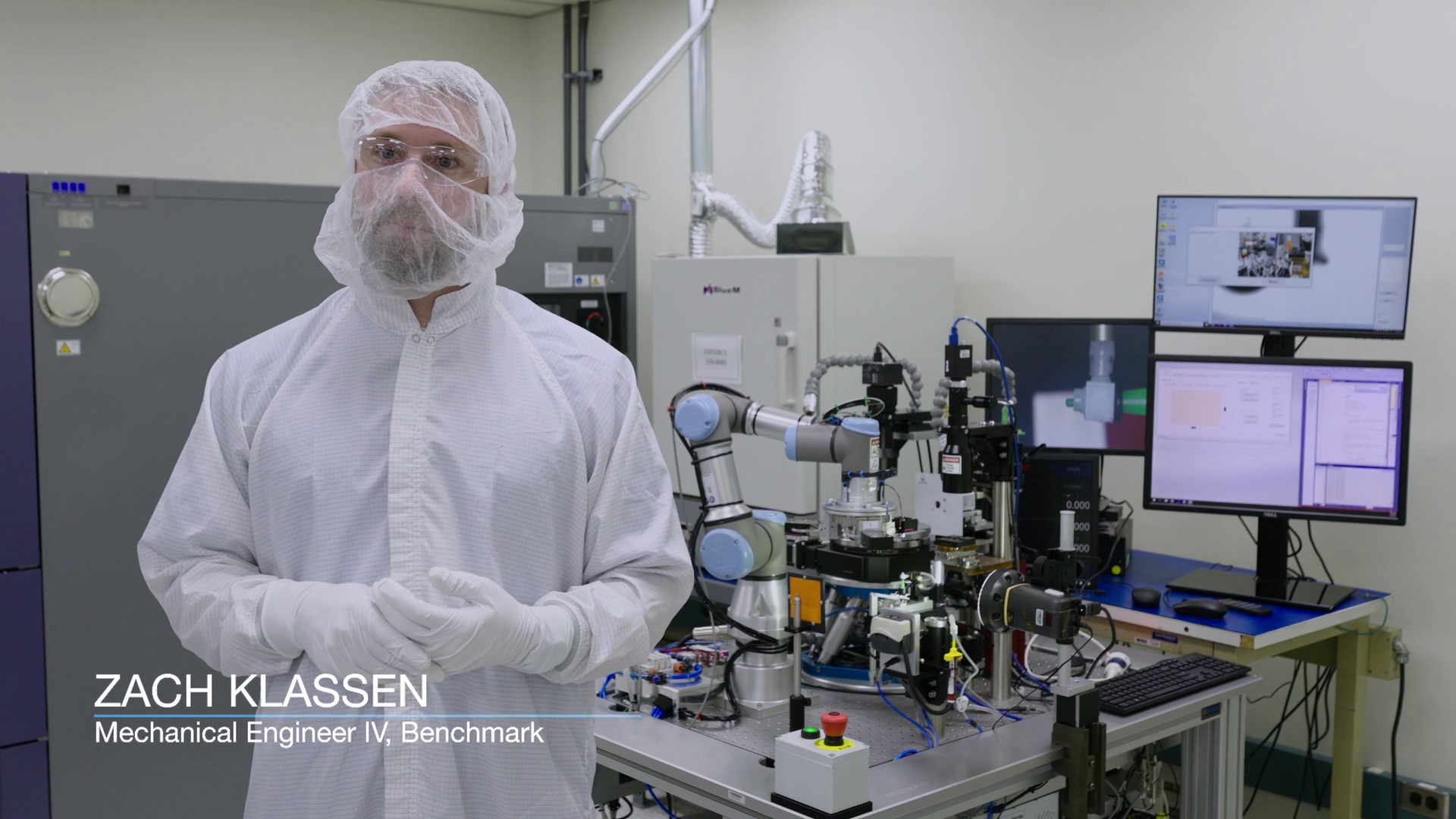
This automation-first approach offers a vital advantage. Because all of the advanced automation technology is incorporated at the onset of the prototyping phase, the system for full-scale production is already in place. This means that as soon as your prototype is complete, you are ready to run production at scale to the full accuracy and precision requirements of your product. That’s the Benchmark approach to precision optics. See how we successfully applied this approach to develop and scale an optical assembly for a critical life sciences product. This example perfectly represents the challenges associated with precision optics assembly. The customer had an existing design already in production, but aimed to reduce it size while still meeting performance requirements. They also required rapid assembly to meet their demand targets, a challenging task due to the precision and size required. Their goal was to maintain and improve their competitive edge while satisfying the growing volume, and they needed a partner who could scale with them at the necessary pace.
We responded with our comprehensive approach to precision optics, beginning with design simulations, identifying areas for improvement, considering trade-offs between assembly methods, and constructing the automated setup that would be used for prototypes, as well as full-scale production. We successfully created prototypes that performed just as well as the existing design, reduced component counts, and built the automation solution for both the optical system and the housing assembly. We helped them scale production while ensuring quality and precision remained consistent. The result was a significantly improved life sciences device that helped our customer solidify their market lead.
Differences in Engineering and Manufacturing Partners
With numerous manufacturing partners available, why choose us? At Benchmark, we focus on products that matter, from semiconductor capital equipment to lifesaving medical devices and critical defense systems, giving us the experience to handle the most complex systems. We build our processes to fit your designs, not the other way around. Others may reject your design if it is too complex, having suited their setups for simpler designs and high-volume production. Thus, they may shoehorn your design into their automation process. It only makes sense when they’ve made the investments in the high-volume machinery they use. Often, they are also unable to improve your design without outsourcing the engineering work, leaving questions and vulnerabilities in IP protection. Finally, other partners often lack the adjacent engineering expertise required, or if they do possess it, may not have the experience in combining these elements for optics. Benchmark addresses these concerns with the approaches outlined above, and our experience is a testament to the power of our capabilities.
Building precision optics from simulation to scale is an extensive process encompassing many engineering disciplines. Successful execution requires more than a serial process. Manufacturing and product lifecycle considerations must be involved at the very beginning of design. In the next part of our series, we will dive deep on the details of our process and explain things like optical tolerance analysis, passive vs active alignment, and how we ensure quality during production
Do you have a precision optical design that could benefit from a smaller size, better performance, or automated manufacturing, but don’t have the right partner? Contact us here and create a path to a powerful, yet manufacturable optical design.


