Businesses around the globe are joining the Smart Grid Revolution in a concerted effort to improve electric-power efficiency and reliability today while preparing for even more devices, users, and as yet undiscovered needs tomorrow.
Setra Systems, a leading producer of premium sensing solutions, has forty years of experience solving their customers’ energy management and environmental control challenges through technology. When they reached out to the Benchmark European Design Engineering Group, they were looking for a streamlined solution to integrating sensors, edge processing and connectivity to give customers new abilities to manage their energy consumption efficiently. The outcome resulted in an energy-management device—built on a Smart Edge Gateway Platform—that leverages machine learning-derived algorithms to quickly triage and process information for consistent reactions to the inconsistent flow of electricity.
This solution is simple, elegant, powerful, secure, and ultimately limitless in how it can be scaled and used in future devices. Ready for tomorrow’s needs today, it’s IoT edge innovation at its best and a key differentiator in the Smart Grid market.
“The ability to relay data between the cloud and a device on the edge enables powerful machine learning for localized, real-time decision making that can reduce power consumption and ultimately carbon emissions. That’s IoT edge innovation at its best.”
The Challenge: Secure, Flexible, Connected Energy-Management Devices
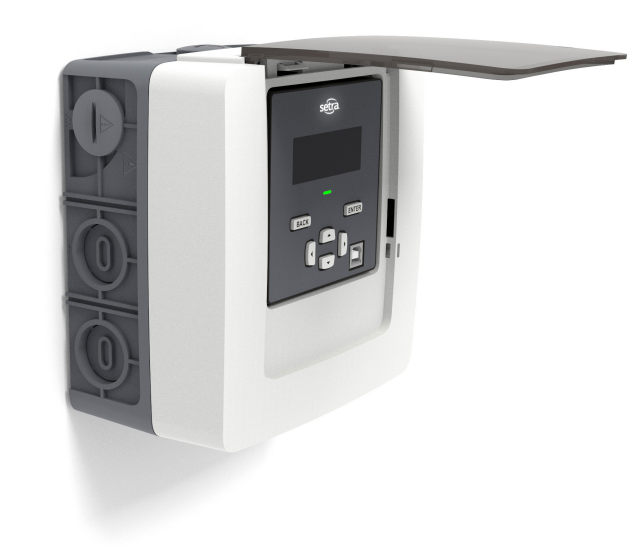
Setra requested that Benchmark develop new technology for their Setra Power Meter, an in-line connected meter that can track and manage electrical flow throughout a large commercial building.
The proposed device also had to be secure, broadly configurable for a variety of buildings, and flexible enough to work with any type of connectivity and cloud service that an end user might need. Most importantly, there could be virtually zero latency between a change in the electrical current detected by the meter and the local control system’s response.
And, like all Benchmark solutions, it had to launch as a future-ready foundation for reduced time-to-market, and interoperability to support any new products in the customer’s pipeline.
The Solution: Smarter Smart Grid Management at the Edge
Keeping all required features front-and-center, the Benchmark team in Almelo, Netherlands, delivered an innovative energy-management device that offers significant computing power and reliable connectivity for data transfer between the cloud and the edge. Now, end users can send all data to the cloud for a period of time—so machine learning can train the algorithms— then load the algorithms onto the gateway to enable brilliant Smart Grid management at the edge.
The new device also can aggregate and pre-process information on the gateway itself to reduce the amount of data sent to the cloud. Both applications function simultaneously to reduce, or even eliminate, the impact of latency on the system. Additionally, Near Field Communication-supported nodes and sensors make it simple for end users to integrate with existing systems.
A Look Under the Hood: Smart Edge Gateway Engineered by Benchmark
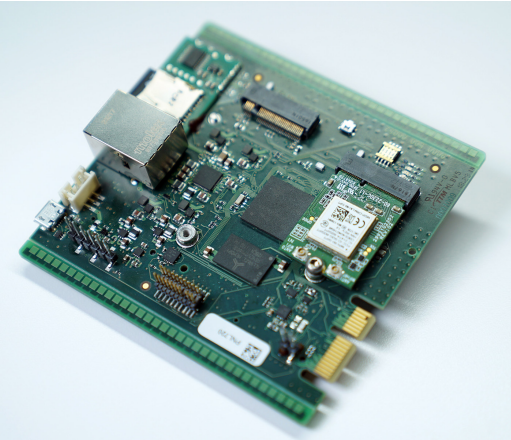
To bring this solution to market quickly, Benchmark leveraged our Smart Edge Gateway Platform as the underlying technology. It includes multiple connectivity types, four extension slots, and all the protocols that an OEM customer might need (Ethernet/IP, ProfiNet, ProfiBus, DeviceNet, Ethercat, CANopen, Modbus, CC-link, Ethernet-Powerlink and Sercos) as well as software that connects to nearly any cloud service.
No matter the industry, any device that handles such a high quantity of real-time data also needs to be secure. Benchmark’s Smart Edge Gateway Platform utilizes end-to-end encryption software and a Trusted Platform Module to make it ultimately fortified, overcoming a common obstacle to successful custom IoT device design.
Further, to help customers respond more quickly to future product development, the platform is highly customizable and can perform a variety of data triage or control tasks at the edge—thanks to System on a Chip and Linux OS technology.
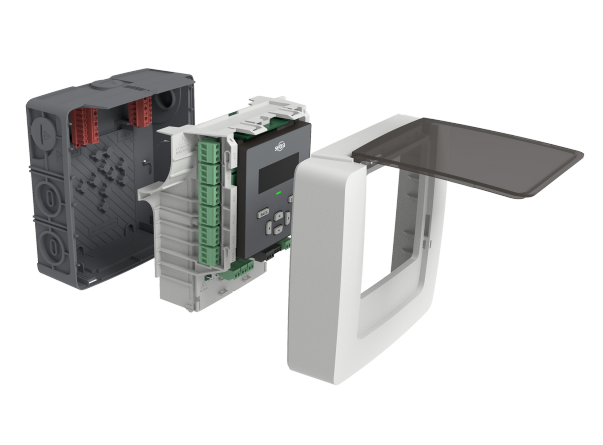
With the gateway as the “engine,” Benchmark’s industrial design engineers developed a modern, versatile design for the overall energy management device that provides easy installation wherever the end user needs power management. Benchmark engineers integrated the Smart Edge Gateway Platform and other components into the device design with manufacturability in mind, allowing for a cost-effective and reliable production process.
Leveraging Benchmark’s entire engineering team, from the gateway platform to final production, reduced product risk for Setra Systems and helped bring innovation to market quickly.
The Benefit: Future-Proof Results
For Setra Systems, the incentive behind engineering an energy-management device built on a smart edge gateway is to create value for end users, not only by providing exceptional power management but also by reducing energy costs and carbon emissions while delivering data that can drive future energy-management decisions.
The Benchmark platforms and capabilities that made Setra System’s ideas a reality are helping Benchmark customers across industries achieve their product goals. The Smart Edge Gateway Platform is flexible, secure and powerful, making it an excellent platform for everything from medical devices to factory automation hubs. With expertise in industrial design and a broad range of connectivity solutions, Benchmark engineers design devices with optimized hardware and software architectures that create excellent user experiences.
Other Embedded Gateway Use Cases:
Because it makes data loads sent from remote locations far more manageable, this enhanced platform means the sky’s the limit for new products. Other use cases include, but are not limited to:
• Connected medical device management
• Factory automation
• Pipelines and oil fields
• Smart cities applications
About Benchmark
Benchmark provides comprehensive solutions across the entire product lifecycle, leading through its innovative technology and engineering design services, leveraging its optimized global supply chain and delivering world-class manufacturing services. The industries we serve include commercial aerospace, defense, advanced computing, next-generation telecommunications, complex industrials, medical, and semiconductor capital equipment.