
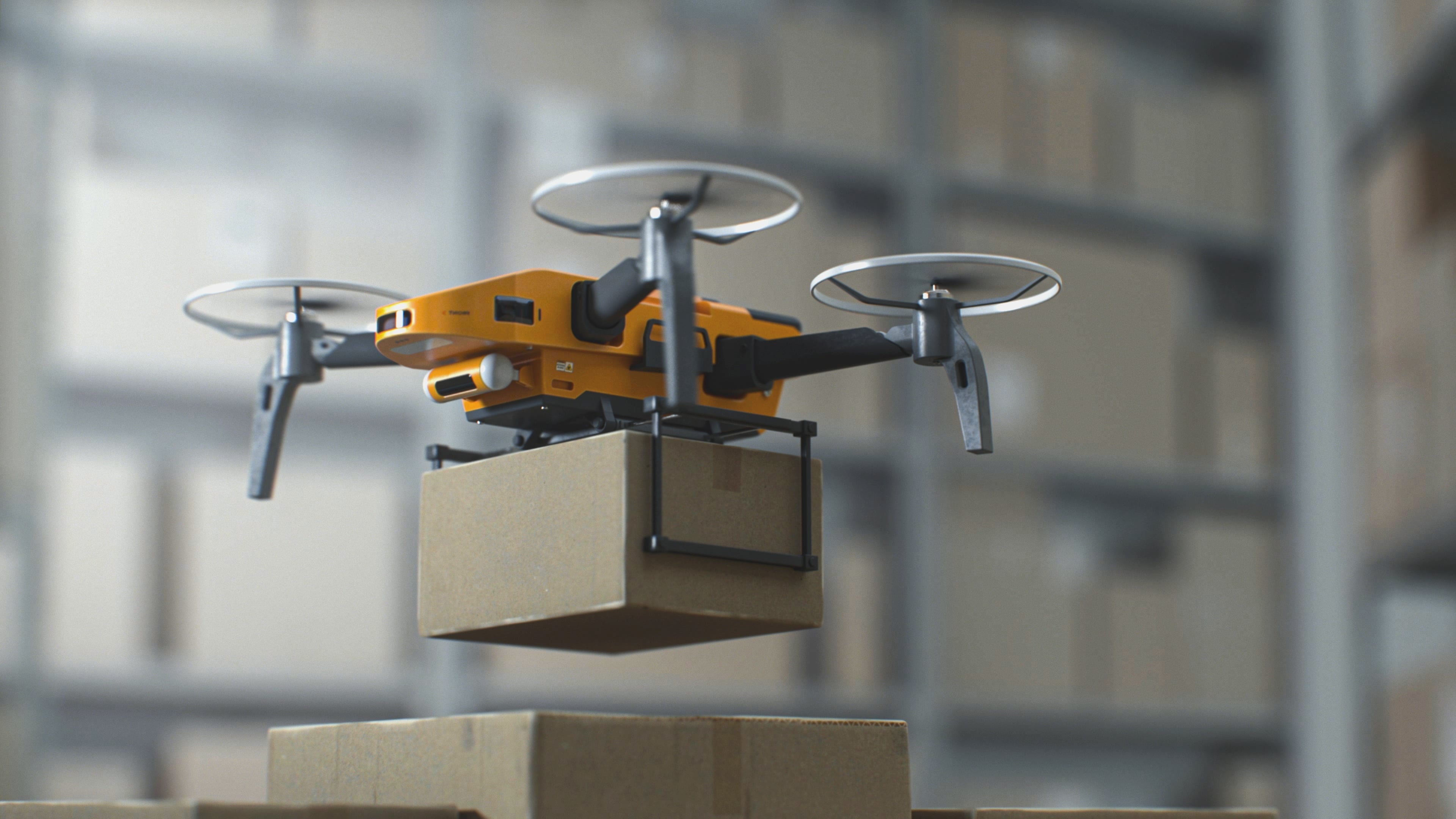
A functional test system was engineered to validate a UAV communications module at both board and device level inside one RF-shielded fixture, covering programming, power, memory, temperature, BLE, and cellular Tx/Rx testing.
Quick Facts
• Test Target: UAV communications module (cellular modem, BLE remote ID, MCU, power management, Ethernet PHY, EEPROM, temperature sensor)
• Coverage: Programming, voltage/current, memory verification, BLE, temperature, cell modem ID, cellular Tx/Rx
• Design Highlight: Board-level and device-level tests in a single RF-shielded fixture, consolidated to one USB RF bulkhead
The Challenge: Validating Every Function of a Connected UAV Module in One Fixture
As uncrewed aircraft move into regulated airspace, the communications modules that keep them connected have to be validated with total confidence—covering power, data, wireless links, and remote identification in a single production-ready build. This module combined a cellular modem, a BLE radio for remote ID, an MCU, power management, an Ethernet physical-layer chip, EEPROM, and a temperature sensor, all connected through a single Power-over-Data-Line (PoDL) interface carrying 12 VDC over a 100BASE-T1 differential pair. Every function had to be verified quickly and repeatably on the production floor.
How the Tester Was Engineered: Turnkey Test Development, Design-Integrated
Building a manufacturing-ready tester for a mixed-signal RF module means engineering it to fit the assembly process and consolidating instrumentation for repeatable results. That is the turnkey test-development approach Benchmark applied, with test engineers working alongside design engineers from the start. The system performs programming, voltage and current tests, memory verification, BLE checks, temperature tests, and cellular modem identification plus Tx/Rx testing. Both board-level and device-level tests run inside a single RF-shielded fixture using dedicated antennas for each stage. Beneath the enclosure's top plate, the automotive-Ethernet media converter, programmer, DIO, BLE board, and fixture interface were consolidated onto a compact hub—reducing the design to a single USB RF bulkhead. Best-in-class instrumentation from B&K Precision, Rohde & Schwarz, NI, and Keysight is orchestrated through NI TestStand, LabVIEW, and Python.
The Results: One RF Fixture, Full Board-and-Device Validation
• Complete functional coverage—programming, power, memory, temperature, BLE, and cellular Tx/Rx—in one platform
• Board-level and device-level testing in a single RF-shielded fixture, consolidated to one USB RF bulkhead
• A manufacturing-ready tester that accelerates production readiness for a demanding, FAA-regulated application
By pairing design and test engineering under one partner, Benchmark helped a commercial aerospace innovator move faster from development into reliable, repeatable manufacturing.
FAQ
How do you test a UAV communications module at both board and device level?
Engineer a single RF-shielded fixture with dedicated antennas for each stage, then integrate programming, power, memory, temperature, BLE, and cellular Tx/Rx tests into one platform. Consolidating instrumentation—down to a single USB RF bulkhead—keeps results repeatable on the production floor. Benchmark used this approach to build a complete functional tester for an FAA-regulated UAV Communications Module.
What instrumentation is used to test a cellular and Bluetooth module?
A typical setup pairs a programmable power supply, a wideband radio communication tester, a DMM, and DIO with an automotive-Ethernet media converter and BLE dongle, orchestrated through NI TestStand, LabVIEW, and Python.
