When Ouster, a leading provider of high-resolution low-cost Lidar sensors for autonomous vehicles, robotics, security, and mapping was ready to scale production, they needed a partner with a unique combination of microelectronics, optics, printed circuit board assembly, and automated testing capabilities. Benchmark worked hand-in-hand with Ouster to develop a reliable, scalable production process using Benchmark’s global manufacturing and supply chain network.
The Challenge: Building Better Lidar
Although Lidar’s potential as a key technology for autonomous vehicles has led to exponential growth in the Lidar market over the past decade, challenges with adoption of the technology remain.
To overcome these problems with the goal of becoming the de facto provider of next generation Lidar solutions for autonomous vehicles, Ouster developed high-resolution digital Lidar that captures intensity information in 16-bit granularity for rich, detailed digital image data.
Ouster’s Lidar technology works by creating uniformly spaced point cloud and pixel-aligned 2D camera images to enable more efficient data processing, faster labeling and a streamlined algorithm application. Ouster’s devices are built to withstand real-world environments with dirt, dust and water, as well as heavy shock, vibration, and temperatures as low as -40º C and as hot as +85º C. Affordability is a key aspect of Ouster’s value proposition to automakers who will require multiple Lidar units per vehicle for full-autonomous driving.
When the time came for Ouster to scale production of their excellent design, they couldn’t choose just any manufacturing partner. The design required proprietary microelectronics assembly with precision placement accuracy of some components. They needed a partner that could implement a manufacturing process that was both repeatable and efficient, as well as execute unique and test processes. With a deeper understanding of the product, Benchmark was ready to transfer the manufacturing process.
Working closely with the Ouster team, Benchmark engineers were trained on a multifaceted manufacturing and testing process that included precision microelectronics assembly of the sensors, sensor alignment, optical lens assembly and alignment, and turntable base subassembly and sensor integration, which allows the Lidar sensors to provide 360-degree coverage of the road and objects.
These processes are critical to the quality of the system and the ability to scale production. Benchmark worked closely with Ouster to identify opportunities to improve and automate certain aspects of the existing captive low-volume process, as well as determining which steps needed to remain unchanged to ensure the product would perform at the level Ouster’s customers expected.
One of the key components that Benchmark needed to deliver at volume was the turntable. From an outside perspective, the turntable might seem like the simplest step. However, the turntable itself is an electromechanical assembly that houses a stack of five printed circuit boards built up to create a motorized, rotating electronics assembly. The optics portion using Lidar sensors is installed on top of the turntable electronics. The quality of the device depends on stable and repeatable manufacturing.
When the unpredictable conditions of roads and weather are factored in, the manufacturing quality and capability are essential to the device performance. Benchmark applied its mechatronics expertise to manufacture the high-reliability design to Ouster’s specifications and was able to meet the level of quality needed for the turntable to perform in any condition.
The assembly and manufacturing of the Lidar sensor also has challenging requirements. For example, the microelectronics assembly of the vertical-cavity surface-emitting laser (VCSEL) and single-photon avalanche diode (SPAD) stacks have a 1.5 micron placement tolerance. Benchmark has performed sophisticated manufacturing for telecommunications, defense and test procedures to ensure the quality of each sensor. Despite these distinctive requirements, cost was still important so that Ouster could keep prices low for their customers.
In order to meet the demand of autonomous vehicle manufacturers around the world, Ouster turned to Benchmark for its capabilities and expertise in microelectronics, optics, pcb assembly, automated testing, and its network of global resources to scale production.
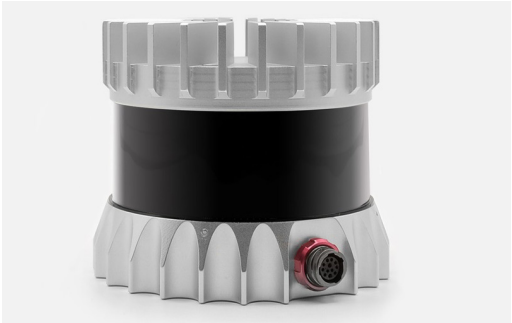 Photo Credit: OSU ultra-wide view Lidar sensor, photo courtesy of Ouster
The Solution: Advanced Microelectronics and Precision Assembly
One of the key benefits of working with Benchmark is the passion its expert team of engineers put into every project, and the extra mile they go to solve complex challenges. Before the manufacturing process implementation began on the turntable and the electrical and optical components for the sensors, Benchmark needed to understand Ouster’s product requirements and unique manufacturing and test processes.
At the beginning of the partnership, Benchmark’s process engineering team spent six weeks in San Francisco with Ouster engineers learning about the product and the current low-volume manufacturing medical products and leveraged this experience for Ouster’s Lidar system. The requisite processes were successfully implemented employing fully automated, state-of-the-art equipment in collaboration with Benchmark technical expertise.
To meet Ouster’s needs and to produce the device at volume, Benchmark customized two Class 10,000 (ISO Class 7) clean room areas of its Thailand facility to produce the Ouster products at volume. This included configuring a custom microelectronics line, a full-sensor assembly line, and an end-of-line (EOL) test room for the finished automotive devices.
The Results: Bringing the Next Generation to Advanced Lidar to Market
Benchmark used its expertise in microelectronics and optical assembly to help Ouster develop a high-quality Lidar solution. With its global resources, Benchmark is able to produce thousands of units each month to meet the demand of Ouster’s customers and scale up for future business growth.
The collaborative efforts of Ouster and Benchmark also allowed the teams to stay on budget and achieve the milestones of the project. Benchmark leveraged its global supply chain to find low-cost components. Ouster’s decision to use Benchmark’s Thailand facility, which is a region known for its expertise in photonics and low-cost, high-skilled labor, provided Ouster a number of advantages. Now as full production is ramping, Ouster customers have the device technology they need to make fully autonomous vehicles and other systems a reality.
 Photo credit: Final Product functional testing Lab
About Benchmark
Benchmark provides comprehensive solutions across the entire product lifecycle, leading through its innovative technology and engineering design services, leveraging its optimized global supply chain and delivering world-class manufacturing services. The industries we serve include commercial aerospace, defense, advanced computing, next-generation telecommunications, complex industrials, medical, and semiconductor capital equipment.