About the Customer
Benchmark collaborated with a prominent biotechnology research equipment company known for its innovative gene analysis tools and real-time biological observation technologies. This company specializes in developing advanced technologies that have established new standards in the field, significantly advancing DNA sequencing and related research methodologies. Its pioneering efforts have greatly influenced modern approaches to biotechnology.
The Challenge
One key factor contributing to the success of the customer’s next-generation life sciences system was the reduction in the size of their existing laser steering module (LSM) while still maintaining its critical function of focusing laser energy and precisely directing it to a specific location on their proprietary disposable chemistry module. Additionally, the customer required that the assembly processes for the LSM in production be automated to meet tight design margins and enhance overall production efficiency. When miniaturizing optical assemblies, design parameters can be significantly limited by the type of assembly technology chosen for manufacturing the device. At the same time, selecting certain design elements over others can significantly increase the manufacturing costs of the unit.
The Solution
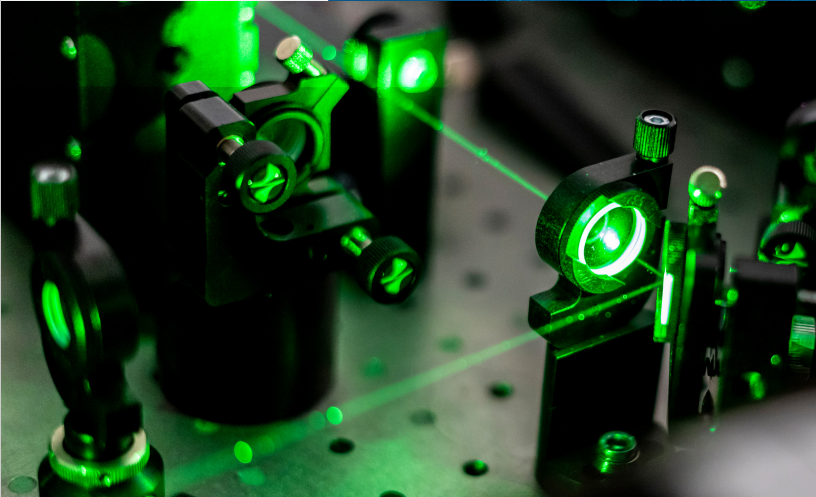
Benchmark’s team worked closely with the customer to enhance their initial design, reducing the size of the laser steering module while simultaneously developing the automation solution. By incorporating advanced optical components and sophisticated manufacturing processes, Benchmark created a laser beam steering and aiming device capable of directing laser energy from a commercial laser source into the customer’s chemistry module with micron-level precision.
Benchmark’s engineers collaborated with the customer’s engineers to conduct several rounds of design, prototyping, evaluation, and redesign to refine and improve the device. Creating prototypes that perform similarly to production-ready designs is challenging in optical products, as the manufacturing processes used in the development phase can result in prototypes that perform very differently from a production-ready device built using automation. Benchmark utilized a flexible, modular prototyping system that can be adapted to manufacture optical prototypes that accurately represent the unit in volume production. The system allows engineers to achieve extreme precision in temperature control, positioning, and other critical factors. As our client continued refining their internal processes, our prototypes adapted to their evolving needs, allowing them to proceed confidently.
The modular prototyping system also allowed Benchmark engineers to develop the volume manufacturing process in parallel with the design efforts. Each round of prototyping provided data not only on the design but also on the manufacturing process. Today, the LSM is produced at volume using a variation of the prototyping system.
Benchmark engineers also reduced the number of printed circuit boards by integrating functionalities to optimize performance in a smaller form factor.
While the size of the boards for movement control and data reading could not be greatly reduced, the engineers strategically minimized the overall component count to save on Bill of Material and manufacturing costs. This simplification of product design did not compromise functionality.
The redesigned laser steering module successfully achieved the size reduction goal while ensuring that laser energy was accurately focused on the product, targeting the critical location with extreme precision.
The Results
The project successfully reduced the size of the Laser Steering Module (LSM) while developing a cost-effective manufacturing process for use in volume production. This strategic enhancement enabled the customer to provide a device for conducting sensitive research while effectively minimizing the risk of cross-contamination, a key objective.
By leveraging our automated platform to assemble the Laser Steering Module, we enabled our customer to bring their product to market more quickly. This approach helped them avoid significant capital expenditures that would have been necessary had they chosen a different path. The resulting flexibility positively impacted our customer’s cash flow, allowing for support for other growth initiatives.
About Benchmark
Benchmark provides comprehensive solutions across the entire product lifecycle, leading through its innovative technology and engineering design services, leveraging its optimized global supply chain and delivering world-class manufacturing services. The industries we serve include commercial aerospace, defense, advanced computing, next-generation telecommunications, complex industrials, medical, and semiconductor capital equipment.
Download the Advanced Manufacturing Prcesses fpr Laser Steering Module Case Study (PDF)