About the Customer
Benchmark’s customer is an innovative, agile company focused on developing single-use surgical medical supplies. The company works closely with physicians to develop products that improve patient safety by reducing infection risk while maintaining strict adherence to quality standards.
The Challenge
The customer’s goal was to design and build a single-use arthroscopic device. By using this device, surgeons could prevent infections caused by accidental lack of sterility, which is a risk with reusable scopes. The removal of this risk would improve outcomes for the patients, surgeons, and insurance companies involved in this type of surgery.
Arthroscopes are complicated instruments with a system of lenses, a camera, and other components. The complexity and cost of typical arthroscopes are key factors contributing to the practice of reusing scopes. The customer needed a partner capable of designing a high-complexity arthroscope using a design-for-cost approach that considered both material and assembly costs to make single-use arthroscopes financially feasible.
The customer had an idea that would benefit patient outcomes, but needed a team of technical experts to bring it to life.
What is an arthroscope and what is it used for?
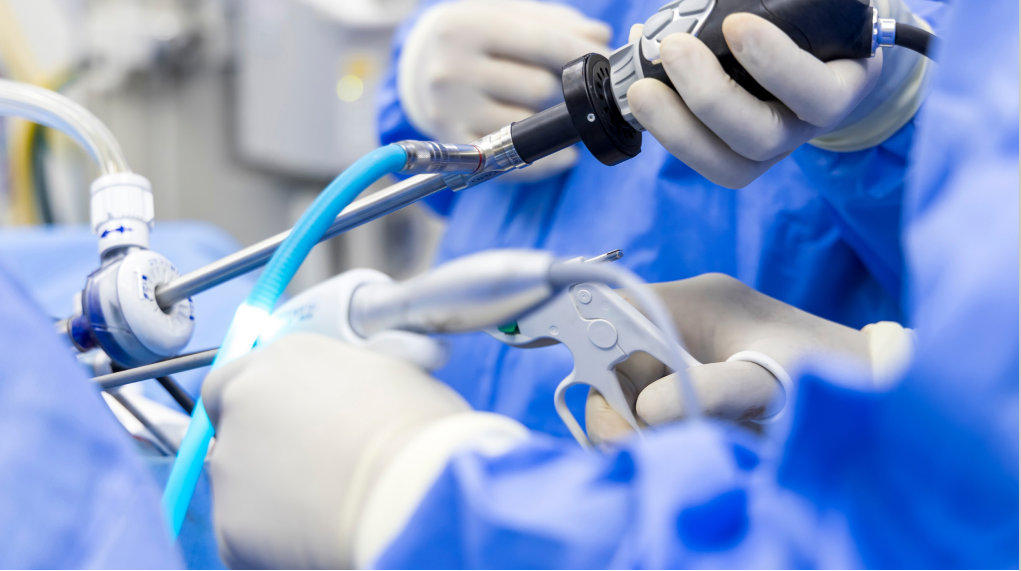
An arthroscope contains a system of lenses, a fiber-optic camera, and other electronics and custom housings to allow surgeons to directly visualize the insides of joints in high definition. Arthroscopes can be used for diagnostics and treatment of problems in hips, wrists, knees, shoulders, and other joints.
Arthroscopic surgery has numerous benefits for patients when compared to open surgery. Arthroscopic surgery uses tiny incisions, often less than one centimeter, resulting in less damage to the surrounding tissue and minimal scarring for the patient. This technique also typically results in less pain and a faster recovery, and patients often go home the same day and return to normal activities more quickly. Arthroscopic surgery is a common option to address conditions like meniscus tears, rotator cuff injuries, or joint debridement.
While arthroscopic surgery is generally considered low risk, infection can occur if arthroscopes aren’t properly cleaned and sterilized between uses. Because arthroscopes are inserted deep into joints, any contamination can lead to a serious joint infection, known as septic arthritis. Single-use arthroscopes remove this risk to patients by eliminating the need to reuse instruments and ensuring every arthroscope is free of contaminated biological debris.
The Solution
Benchmark started supporting customers by manufacturing complex medical products over 40 years ago and has continued innovating and pioneering medical technologies over the decades. Its expertise made the company a clear frontrunner as a partner for this project.
Benchmark’s previous experience with similar medical devices included redesigning an ingestible camera with an optical assembly. The Benchmark team successfully simplified the design of the ingestible camera while improving its flexibility and durability. These improvements were critical enhancements to the camera’s ability to navigate and capture clear images inside the small intestine, an area notoriously difficult to view with other technologies. Benchmark also developed and verified the full manufacturing process, designed and built custom assembly and test equipment, and implemented rigorous medical device manufacturing controls to ensure consistent quality and performance.
Besides this project, the Benchmark team also had experience designing a disposable endoscope for an industry-leading medical company.
Impressed by Benchmark’s proven track record with complex medical devices, the customer chose them as the engineering partner to bring this high-stakes arthroscope project to life.
For this project, Benchmark first met with the customer to understand its objectives for the finished product. Benchmark’s team worked closely with the customer through the product realization process, including performing risk analysis and creating concept work before moving on to the formal design. The teams had weekly calls to review processes, and they closely collaborated to ensure all technical and financial specifications would be achieved.
The customer’s goals for this project included reducing the number of components in the arthroscope by at least half. Additionally, the finished product needed to be disposable and low cost, both in design and in the manufacturing process.
By combining lens elements, Benchmark’s optical designer was able to modify the original design and achieve the same image quality using fewer lens pieces. He used specialized optical software to look at the curvature of the lens and refraction, making adjustments with gradient-index lens optics.
Next, Benchmark’s team looked for off-the-shelf lenses that met the arthroscope’s new design specifications. When they learned the appropriate lenses didn’t exist, the team created custom lens prescriptions, allowing them to improve the design’s optical performance even with fewer components. They used these in the optical simulation software to confirm the results.
The Result
Benchmark’s engineers exceeded the customer’s expectations, drastically reducing the number of optical elements required in the arthroscope’s design, from 28 to 10—a reduction of 64%, which surpassed the customer’s original target by 14% . While the original piece had too many optical interfaces and too much associated complexity, Benchmark’s team redesigned the product to achieve optimal performance while simultaneously reducing components for minimal cost. Additionally, the redesigned arthroscope achieved improved optical performance when compared to the original design.
With its revolutionary design, Benchmark’s team created a lower-cost, disposable arthroscope design with enhanced imaging capabilities and fewer components, providing the customer with the opportunity to make large-scale production feasible and helping them take a major step toward market readiness. The result was a product designed to support safer surgical outcomes, keep up with evolving medical standards, and to position the customer as a forward-thinking leader in the surgical device space.
 Previous design - exhibiting noticeable distortion and reduced resolution, particularly at the edges of the optical field.
 New design - showing substantial improvements in both distortion correction and resolution uniformity across the entire optical field.
About Benchmark
Benchmark provides comprehensive solutions across the entire product lifecycle, leading through its innovative technology and engineering design services, leveraging its optimized global supply chain and delivering world-class manufacturing services. The industries we serve include commercial aerospace, defense, advanced computing, next-generation telecommunications, complex industrials, medical, and semiconductor capital equipment.